Showing posts with label a and p mechanic. Show all posts

Tuesday, January 5, 2016

2016! Time for some Maintenance Goals (or Goaling as the new hip way of saying it is!)

Every year people go through this whole resolution or goaling thing when the New Year is upon us. I've decided to try and put together some Maintenance Goals that should be attainable for all of us aircraft mechanics.

I typically do not make any resolutions but I think this could be a fun exercise for the heck of it.


Goal #1

Stop worrying about delays while working on planes.

This is a tough one. The company will always push you to work quickly and to work in a way so as you take minimum delays. Delays are bad, they cost the industry millions of dollars every year. Delays are most likely to be caused by weather, crew scheduling or air traffic control, however maintenance delays are an issue too.

My contention is that a delay caused by a mechanic fixing a broken plane should not be lumped into all those other types of delays. We are talking about  safety of flight in most of the things that end up being maintenance delays so a departure time should be the furthest from your mind while you are trying to troubleshoot an issue.


My goal would be (and has been) that I will not rush, rush, rush to fix a plane. I will take my time and double check my work if necessary to ensure I have made no mistakes. I do not give estimates of "when I will be done" unless I'm pretty sure of what I'm doing. In essence NO PROMISES.

As an added "word to the wise", the company will rush you and try to get you to work quickly (understandable, they are in business to make money) BUT if by chance you mess up and the FAA has to get involved you will see just how fast the company will dump you and disavow any knowledge of how or why you did what you did. It is up to you as an A&P to check your own work and to be absolutely sure that when you sign off something it is done right.
 
Goal #2

Meet an "old school" mechanic and learn something from them.

I've had the honor to work with some of the "Old Timers" in our industry. I was employed at my job at the right time. The time when these guys were still eager to teach a new guy and when they could still say something like "hey jackass you are doing it wrong!" and not get into trouble.

I'd love to hear some stories from these guys1


These guys are a wealth of knowledge and should be idolized by the young A&P mechanic. I worked in the microfiche/get a bigger hammer era and the stories and wisdom will help you grow and amaze you.

Goal #3

Teach a new hire something.

The new guys are the future of the industry. Instead of complaining about how these new guys don't know anything or are too lazy to learn the right way lets show them the light!

They will always remember you for it and it makes your job easier if they do it right the first time.

Goal #4

Get your money straight (retirement)

Ok, it's great to fight for the next pay raise and to stick it to the company with a nice new fat contract. What has concerned me for a while now is how little our A&P brothers and sisters think about their retirement.

Let me tell you a story; Not too long ago I was one of those people. I figured that I would likely work into my 60's and or 70's and retire. It's a common thing for A&P mechanics to work that long, retire and within 2 or 3 years they die.


It is very important to think about how you want to live when you do retire, when you want to retire, and what you wish to do when you do retire. I am of the opinion that the earlier you can retire the better. We work in a highly toxic field. The shorter the exposure you can have to these chemicals, etc the better.

My wife came to me about three years ago with concerns about  our lifestyle after we do retire. We have since been investing in commercial real estate and enjoying making money while sitting at home watching TV!

What I'm saying is that 401ks are great but remember that about half of your 401k money is going to be taken by the government as taxes when the time comes. The trick to retirement in my opinion is to diversify. Keep your 401k, add some alternative investments, add some commercial real estate to "recession proof" your investments and start planning for your golden years.

Keep in mind that the S&P 500 ended the year down -0.75% (as a total yearlong average). Since I got myself diversified I made an average of 6-7% on my investments!

If any of you out there wish to learn more about commercial real estate investing check out www.waypointpropertygroup.com and learn more about it.

Goal #5

Be safe.

We have chosen a pretty dangerous career. Running engines, flying rivets, sharp metal, poison gasses, oil, fuel, grease, you get the idea.

You want to be able to go back to your family at the end of the day so watch your back!

It's up to us to be vigilant with our own safety.


Happy New Year and let me know what your maintenance goals for the year might be.

Wednesday, September 9, 2015

The Day The Hits Just Kept on Coming!

It started off as a normal day: Oil calls, tray table latches, some minor avionics issues. Then, suddenly the tide started to change:

We got a call to look at a First Officer R2 window. The pilot was complaining that the window was "hazed". The mechanic decided to change the window which is only a 10 min job. The trouble started when the "H-Number" on the window which was removed did not match the H-Number of the window being installed.

Typical 737 Flt Deck windows (swa corp security safe pic)


This is a normal situation and as some of you know when these number do not match we have to change the wire position on a terminal block behind the window heat controllers which are located in the E/E Bay (in the belly of the beast).

This job used to be a simple annoyance: remove the window heat controller(s) so you can see the terminal strip, remove the wire and place it onto the correctly number terminal. Of course that is how you would do it on a 737-300 or "Classic" model airplane.

window heat controller (got this pic off ebay-scary) (swa corp security safe pic)


Boeing in its infinite wisdom decided to relocate this terminal strip on the 737-700 or Next-Gen aircraft. This strip is now located behind the forward wall on the forward cargo compartment. Keep in mind that in this instance we are working on a "live flight". This plane has passengers who are trying to get places. When the plane has passengers it will also have luggage. Where do we keep the luggage?-Forward cargo compartment.

So the mechanic had to troubleshoot to a point where he decided to change the window, make sure we had a window in stock, get the window in, and change the "taps" to the correct terminal spot. What do you think happened while he was troubleshooting and changing the window?

Terminal block similar to the one I'm talking about (swa corp security safe pic)


You guessed it, the rampers loaded the luggage into the forward cargo pit. So now he has to explain to the rampers that he needs the bags removed so he can access the wall, take the wall down, and do what he needs to do. Usually this is not a problem but lets face it the rampers are not too keen on unloading the bags they just loaded and it takes time.

So now we are on delay. In about 10-15 mins the mechanic has created a luggage hole or cave big enough to get to the wall.

The wall is now off but just to make sure you really want to accomplish this task Boeing decided to hide this terminal strip behind an angled structural piece which holds said wall up. To reach it you do it blind, once you can establish you are one the correct terminal strip.

These are the things that drive mechanics crazy. New plane-it should be designed in a way to help us do our jobs easier.

That's not the end of that story either. Once done and about 40 mins into a delay there was a problem with the new window (paperwork type problem) which almost required the mechanic to put the old window back in place doing this whole dance over again! In the end the paperwork question was cleared up but only after another hour was wasted by calling Engineering and all the important people in Dallas.

The next hit to us was self inflicted (by flight crew). The entry door got stuck on the jet bridge extendable canopy. Happens all the time. The OPS people usually will call MX and we can easily unstick it. This time the Captain did not want to call us, he told the OPS person to just move the jet bridge back.

L-1 Door (swa corp security safe pic)


The jet bridge moved back and the hinge and guide arm on the door got all bent up. I've changed guide arms and usually it can be done in about an hour but that hinge (hinge plate actually) is another story. We grounded the plane and I and another Mechanic worked on it for the rest of the shift. It turns out that to replace these hinge plates the door has to be removed from the plane! Last time I removed a door form an airliner was way back in my Delta Airlines days.

We get off shift at 10pm and as a cherry on top of our great day two planes struck winglet to winglet right around 9:30pm. The airplane gods were not happy that day! The only silver lining was that none of the "Damage Events" (sounds like a movie on SciFi Channel) were caused by maintenance.

Winglet (swa corp security safe pic)

Thursday, May 28, 2015

CSI Aircraft Maintenance (Cue Theme Music!)


As an aircraft mechanic we encounter a lot of mysteries. Sometimes the mysteries are as simple as:

Why won't this light come on?

Where is this fluid coming from?

What kind of fluid is this?

Much like that TV show CSI we are trained to dissect the problem in order to solve it. It's one of the things that I think really makes the job enjoyable. When you can figure out what is wrong with a component it's very satisfying. Follow the clues and figure it out.

Most problems are not this obvious!


For this reason it is important to hone your skills by learning to read wiring diagrams, prints and such. Also, even though it is a huge pain in the ass, you will need to get your Run and Taxi license as well as your CAT ticket. These things help us to correctly troubleshoot!

Not as hard to read as it would seem.


Sometimes (and this is the dark side of it) the CSI reveals that some of your coworkers are lets say- working harder at trying to find an excuse to NOT fix something then it would take to simply fix it.

I'll give you an example. When I arrived at work in the morning one of the planes was broken. The fellow who was working on it is not one of the sharpest tools in the shed. You know the type, always troubleshoots down to the part which is "not in stock."He miraculously cannot get to the hard MEL because he is still "working his check."

Long story short we decided to start the troubleshooting process over from the beginning due to this guys rep. Sure enough within an hour we figured out that this guy lied about what was going on and all we had to do was change "the big part" to fix the issue. Another hour and we had the plane back in service.

So what do you do when you find out a fellow mechanic simply lied to get out of doing work? What can you do? If your leaders (management) already knows about the guy (and they do) there is little you can do. Complain? Sure. But nothing official. Just kind of keep it in the memory bank and watch your work when that guy is involved.

There are other times when we do the unexpected (at least to non-mechanics) to solve the mystery. A pilot will call us about a leak and we show up, first thing we do is touch it and rub it between our fingers, smell it, and sometimes to the horror of the pilot you taste it. He or she is in horror but I'll wager that an aircraft mechanic is one of few people who can tell the difference between oil and hydraulic fluid by taste! Admit it once you have tasted hydraulic fluid you can never forget the taste.


There are other times when your CSIing will figure out that the flight crew input some incorrect info into their FMC! Those are great times almost as satisfying as finding the CB popped while the crew is struggling to figure out why some system won't work.

So...keep sharp, never stop learning, be honest and hone those taste buds!!

Monday, April 13, 2015

And now...the end is near!


I have had a great career. True I was laid off and went through two down cycles in the airline industries. I have lost a house and spent a few sleepless nights worrying about how to make it until the next pay check. But, in the grand scheme of things it has been a very successful and profitable career for me.


I was at work the other day and one of my co-workers came in. He said that something interesting happened to him on the way to work. He left his house at 3am and needed some coffee so stopped by the local AM/PM convenience store.

He gets his brew and the guy behind the counter asks him if he is an airline mechanic. Not too big of a leap since my buddy was wearing a SWA Mechanic jacket. He tells the guy yeah and the guy starts asking about the job.

My buddy realizes this guy knows what hes talking about simply by the questions he was asking so he asked the guy what his background was. It turns out he retired from World Airways as a mechanic. "No way" my buddy says. The guy lifts up his shirt to display his World Airways belt buckle!

The airlines used to offer us employees really great pensions. These pensions slowly but surely started to disappear in the 80's and now not one American airline offers it's mechanics a pension plan. As most American companies the pension plans of old have been supplanted by the 401k plan.

The 401k was never designed to be a retirement savings plan but it is what most companies offer and so it is what most mechanics depend on for their retirement savings. There are a few drawbacks to the 401k that are alarming. The most troublesome to me is that it pretty much follows the stock market. Also it is often difficult to switch your investments within the 401k and most plans limit the choices you will have to invest in.


All this has come to my attention because as a person who wants to retire early in life I started doing some studying. Did you know that 75% of working Americans have less than $10.00 saved for retirement? Scary huh?

Long story short what I've learned is that to really enjoy your retirement you must diversify your savings. 401ks are good but you have to have some investments outside of them to really see your retirement savings take off.


Airlines are great, and being a mechanic is a source of pride for me. I've heard too many stories of old airline mechanics working way past the age of 70 and never retiring. Old airline mechanics retiring and having to work at WalMart to supplement their retirement income. Old airline mechanics retiring and passing away within a year or so  because they worked too hard for too long and their bodies are all used up.


The way for me is going to be retiring early rather than later with enough income from my investments to allow me to continue living in the lifestyle I'm accustomed to.


We are all living longer these days. Males tend to live into their 80s these days and that number is going up and up. Will you 401k be able to support you for 20 years after you retire? How about 30 years? Start thinking about it now so I don't have to hear any more stories an old mechanic working at the local AM/PM convenience store after 30 years at World Airways.

Saturday, May 31, 2014

Airports and FOD

One time I tried counting the airports I've been at and actually worked on planes at. I stopped at 17 or 18. Remember that we Line Mechanics at SWA will fly to other airports when a plane breaks down. For example if there is an engine issue in PDX we fly up there to work the problem. It's actually one of the better parts of the job and it another thing that keeps the job from being routine.

As you can imagine it is normal for airports to be kept clean. Usually the airport operations people are very concerned with garbage and stuff like that on the ground in the ramp area. Foreign Object Damage (FOD) is a big concern for a few reasons:


FOD can get ingested in the engine of an aircraft and cause major damage to the fan blades. It will also bounce around the inlet and tear up the engine inlet.


FOD gets run over by planes and get stuck in the tires. I've seen plenty of bolts, nuts, caps, safety wire, stir sticks you name it stuck in aircraft tires.


FOD on the ground will also puncture the tires of the ground equipment such as jet tugs, etc.


FOD gets blown up by the airplanes as they taxi out to the runways and gets airborne. These missiles can hit equipment, other planes and always seems to find an eyeball or two.

Most airports take FOD damage very seriously and clean the ramp areas often to reduce the threat of such damage. I finally after visiting plenty of airports have decided that the dirtiest, most FOD filled, not caring airport of them all is the one I actually work at the most: Oakland International Airport.

Oakland International Airport is filthy. There are places where the dirt and FOD are piled up, wind blown and more than a few inches deep! It's really bad here in OAK and what makes it even worse is that a lot of the debris gets blown right into the Bay. The Port of Oakland people don't seem to care and they can't say that they don't notice it. As you walk into the airport along the service road from the employee lot the trash is piled up along the fence and just pass the fence is the Bay.


I must have gotten numb to it or else it has recently gotten really bad. Every night when the airport more or less is shut down to the public the cleaning crews come out. I'm not sure what they do all night but when I walk in at 5am and there are cigarette butts piled five or six inches deep in the smoking area trash thing and falling out onto the floor it can't be much. There are garbage cans around the ramp area that get filled up, overflow and wait days and days until they get any attention. The sheer amount of trash is astounding really and I'm not sure what to do about it. It has gotten to the point that it is high on the list of things that make me want to leave this job.

When I go to Sacramento or Boise I marvel at how clean the places are. There are FOD buckets around and the airport must come through with sweeper trucks quite often to keep them that way. I'm not sure how SWA allows Oakland to not clean up. They must know that all that stuff is going into the engines etc. No one seems to care much. I mean I grew up in NYC, The Bronx to be exact, in the 70's when no one really cared about littering. That is what Oakland International Airport reminds me of.

Monday, July 1, 2013

When the tools are missing!

If you do any sort of maintenance work, not just working on airplanes, but any thing really you will come upon a time that you realize some of your tools are missing. I'm not sure how things work in other industries but at the airlines we buy and own our own tools. The larger or calibrated tools are supplied by the company but everything else we must buy on our own. Because of this when a tool is lost it is a big deal to us. I'm sure some of you are thinking "great there are planes flying around with "lost" tools stuck in them." While I cannot say that no tool has ever been left in a plane I can say that there are steps that are taken to ensure that this does not happen too often.


When I worked at Delta Airlines in the overhaul hangar some of the older guys would say that they did not lose a tool but rather that someone else thought they could take better care of it.Or that someone else did not like the way I was treating the tool so they took it.

When I first heard this I assumed they were just being funny about a not-so-funny situation. Now, after all these years I have come to realize what those guys meant.


Let me explain:
In our business we have our own tools, as I already explained. Most of the jobs we do only require one mechanic and so there is no trouble. The issue comes when one, two or even three mechanics are working on a job together. Since we purchase our own tools we pretty much all use the same brands of tools: Snap-On, MAC tools, or Craftsman stuff.
Anyone who has done one of the bigger jobs where at least two mechanics are working can tell you that at some point you are passing tools back and forth without first saying "hey make sure you give that back" or something like that. There are times when the tools are all over the place! Here where I work we do our maintenance outside not in a nice clean hangar and often in the rain. Once a tool, especially a smaller tool like a socket hits the wet asphalt it can literally disappear!
Add the weather, the multiple mechanics and the time pressure and you can see why tools disappear.

HMU change


After the work is done comes the quick cleanup and then most times an engine run or taxi check or even a taxi over to the high power run up area. The fix is checked and then OPS wants the plane taxied over to the terminal, paperwork (which now takes almost as long as the actual work) is done and the crew is briefed. The whole time you are thinking about getting the plane back on line so that the passengers can get to where they are going.

Days later you reach into your tool bag, looking for that 5/16 wobble socket and of course it's gone. You think back to the last time you remember using it and sure you remember using it but for what? who was working with you? what was the actual day? Then you simply plan to head to the store and get another.

Sure there are times when you ask around and the tool shows up but more often than not it's gone. There are other times when you reach into your tool bag and pull out a 3/8 open end wrench that looks similar to your but it's not quite the same...

This is where the tools go. It's almost always the smaller tools, they are the easiest to overlook, especially in the heat of the battle.

"Someone else thought they could take better care of it than I did".-makes sense now.

Not my stuff but you get the idea.


Recently I realized that my 1/4,5/16, and 3/8 wobbles are gone. I have had them for a long time and as most of you know they are not cheap! I'm sure someone has them but who? The 3" extension is also gone so it must be with them, at least they won't be lonely!

At one time I would get upset about all this but looking back I know that it's all part of the industry, at least when you work the Line.

I know some of you will say that all of a persons tools should be marked, etched with a name or employee number. If you still believe that then you are new to the industry or being a little naive.

There are some guys who never seem to lose any tools, they are also the ones who never seem to get dirty, makes you wonder how they do it!?!

Wednesday, May 29, 2013

Each One, Teach One

As many of you readers are already in the aviation field you as well aware of the fact that most people who are in the business do not suggest that others enter into it. This is an unfortunate side effect of aviation, to get to where you want to be takes a loooong time and as a result by the time we get to our position of choice we have a tad bit of ill will toward the industry.

Another safe pic!


The majority of us have been laid-off or "downsized" at least once in our careers and it's natural that we don't want others to go through all the adversity that we did. When people ask me about getting into aviation maintenance I like to tell them that it is a great job, but, all the stuff that you have to put up with on the way to the ultimate position is not worth it to most people.

The few of us who hold on and accept the struggle are rewarded with jobs that we love. It may be that the process is the ultimate weeding out system there is. I remember when my wife was just starting her airline career and flew for a commuter airline. They got no pay during training, had to pay for their own hotel during training and as a reward once they were done with training they made about $800/month! I was sending food out to her and about two other pilots just so they could have something to eat. One of the guys I work with has worked at 14 different airlines! That's crazy!

Recently I was asked by a local A&P trade school to participate in their Aviation Open House. Sure I would be representing SWA MX and my boss would be there also, but could I really encourage people to enter into this slug fest of an industry? I thought about it for a while and decided to do it. I think that since this Open House is for young kids around the community and is primarily to foster an interest in aviation as a whole it could be worthwhile. Lets face it we all know that it is easier to work with a person who has a genuine love of aviation than some guy who just in it for the money.

Where it all started for me


Kids should be exposed to all facets of life and why not being a greaser for the airlines? Maybe one of those kids will grow up to be an industry leader and can reflect on the day way back when they met some guy by the name of Goat told them that he really loved his job. I think about some of the people I have worked with that truly hate their jobs. I f someone had told them at the very beginning the truth about aviation maybe it would have saved them 20-35 years of misery and making others miserable. Wish me luck, once the truth comes out SWA might not be asked back next year!

Saturday, April 27, 2013

Certain Planes.....Certain Planes!!

There are times in this industry when it seems that certain airplanes are out to get ya. They come back for the same issue, time and time again. Recently I worked a plane with an EGT issue. The older 737-300s have EGT systems that are very reliable but when a small part of that system goes bad it will throw the whole thing into a spiraling mess.

Nice SAFE pic of one of our planes.


A plane came in with a gauge going blank. A quick check of the history showed that the gauge had already been replaced (twice) as well as the other common culprit (a cannon plug in the engine core). Long story short I left that night and the plane was still broken. Fast forward to the next morning and I'm assigned that plane again. The guys at night meggered the wires ( a time consuming job) and found no faults. The boss was on the line with Boeing and they were busy trying to find a particular grounding post to verify it's security. Before they could get back with us the guy I was working with, let's call him Mr. Baseball, had found the post and together we verified the security of the set up. We ran the plane and all was well so we did our paperwork and let her free.

That plane didn't leave until later in the day and when it was brought to the gate the other EGT gauge was blanking out! We got that one sorted out and away she went, after another gate call about a circuit breaker.

Don't ya miss the old simple days


A week late I got a call for a seat belt or something small and finished it up, headed back to the shop. As soon as I sit down the crew calls back for something else. I fix that and head out again. I almost make it to the shop when they call me back for a third time about a leak or something like that. This time it hits me it's that same plane I spent two days with a week ago!


To cap it all off about four days later I was working some graveyard overtime. I was doing the usual talking and gossiping for the first half hour when I decided I had better check what I was working on for the night. I'm sure by now you have figured out that I was assigned that same plane! Wow. All I can say is that particular plane is soon to be retired so the stalking will soon end.

Monday, March 11, 2013

The Outsourcing Debate

Although I have not heard anything about this recently I guess the pending merger of American Airlines and US Air has brought this debate back up. Most major airlines currently outsource their heavy maintenance. While this is nothing new, think TRAMCO and the like, the newer trend is outsourcing to companies that are not in the USA.


This is a trend that I do not think will slow down or stop anytime soon. Of course the unions are up in arms over this (who can blame them) but the truth is that personnel is one of the highest costs for any airline.

There is the nagging question of regulation at these MROs that are outside the country but I feel that they are being addressed. The FAA requires the MROs to operate with similar regulations as any MRO inside the states-but-who is doing the regulating?

I don't think that any airline would get rid of ALL their maintenance to go the full foreign MRO and contract MX route. They know that NO ONE would take care of the planes as well as their own employees.

Anyway check out this link to read the article that brought all this up in my mind:

Congress Wary of Outsourcing Aircraft Maintenance-Roll Call Policy

Tuesday, January 15, 2013

Remember Them Days.....

I am proud of where we have come as a group here in OAK Maintenance. We have a great work area, break room, tooling, etc. We do a kick ass job every day of the year. I wonder how many of us can recall the "old days" before the success back when we were all afraid of losing our jobs because that feeling of having lost our previous job was still fresh in our minds.

Pic of OAK when the T2X expansion was being built.


I am guilty of it, I drive a nice car with leather seats and cruise control. I like to eat out and go on nice vacations. The difference is that I remember them days! I remember when the car we owned could only make it on local trips, as a matter of fact we had a truck and that truck only sat three, but we are a family of five (actually four at that time). These types of things are what I would like to remind my fellow mechanics about in this post. Some times it seems to me that we have lost sight in the where we have come department.

I'm talking about years ago before the leather recliners, nice salaries and stuff. Let's see who remember them days.

Remember when your wife had to drop the kids off at the work parking lot so that she could get to work on time.

Remember when your wife had to drop you off at work because you only had one car?

Remember using the belt loaders for EVERY tire change AND brake change?!!

Remember the parts shed at gate 17?

15 minute turns?

Coach seating on our planes?!

Do you remember how the roof of the maintenance van got caved in?

How many of us remember driving down to San Jose in the van when there were no seats in the back?

Why is the vans sliding door welded shut?


How about the George Foreman Grill?

Snickers, smokes, and a coke.

Who can remember when we HAD to work 2 or 3 planes each per night or the work would not get done?

Remember finishing up work in OAK, heading to SJC to knock some work out and then going to SFO for some more work? And we were happy to do it!!

Remember calling MX CTRL for troubleshooting help?

Who can recall trying to fix MELs on turns? And days when we tried to have ZERO MELs fleet wide!!

Some of us can remember going to Frank's after work for a drink.


The point I'm making is not that the old days were all that grand. We worked and we worked hard. I think a little struggle goes a long way toward motivation. We worked and sacrificed because that layoff was still a bitter taste in our mouths. I fear that as time goes on, some of have forgotten what that was like.

The jobs we have are as stable as any job can be in the airline industry, but don't let that fool ya. We have all seen airlines make cuts that don't make sense, my goal is to make our work group too valuable to cut.

I have SWA's back because I don't want to go back  to the sharing a car with the wife days.  I'll take my leather seats in my own car and yes please install the seat heaters as well, I'm not getting any younger.

Tuesday, January 1, 2013

Scared of the Flight Crews

I work with a great group of mechanics. These guys have done and fixed planes in all kind of conditions, weather, anytime of day or night. I have seen them improvise and use all manner of tooling and improvised tooling for that matter to fix our fleet. All this makes me wonder why it is that a good number of them are scared of the flight crews.


When I say "scared of the flight crews" I'm not talking about being afraid of them physically. What I am saying is more and more of them refuse to terminate their planes and actually talk to the crews. When our planes land for the night we usually go and "terminate" them. As it was explained to me when I first got hired: you do a quick walk around, check the tires and brakes, then go upstairs to talk to the flight crews and see if they have any sqwacks about the aircraft. This always made sense to me, for one, these pilots are stationed in OAK and you can begin to get to know them and build a relationship with them. I have seen a lot of these guys come home from their very first day at SWA and now they are Captains whom I respect and who hopefully respect me as well. I like to think that when they tell me about something they trust me to fix it. Another thing is that when a crew actually tells you about an issue they go into further detail than you could ever get from the logbook write up. These guys fly these planes everyday and even get to know certain planes so when they say something is off they mean it.

There are a good number of the mechanics who refuse to talk to the flight crews. They will do a very detailed walk around, I'm talking like 20 to 30 mins until the crews are long gone and then go up to the flight deck. They will wait until Operations calls to let them know the plane is ready to be moved, again the crew is long gone. Some won't even go to the planes until they are ready by which time-once again-the crews are gone.


One of the remarkable things about SWA that I noticed when I was hired all those years ago is that all the work groups get along. The pilots and the mechanics get along and that was something new for me, having come from Delta where that was not the case. Perhaps these guys have come from a similar circumstance, who knows?

The thing is the simple act of meeting the crews and talking to them even when they have no problems is an essential part of the job in my opinion. Last month I saw a captain who I had not seen in some time when I went up to terminate his plane. He says "Goat!! I haven't seen you in awhile. Not since I transferred to (another base). Man I miss you OAK MX guys. The MX at (another base) never come out to the terminators anymore."

I let him know that it was becoming rare here in OAK as well and I had no idea why. We both came to the decision that they must be scared of the flight crews........who knows why?

Lightning Strike on antenna

Tuesday, December 18, 2012

The Floor is Making Noises!!

There are times when we are at work and we have to make decisions to ground a plane or not ground a plane. We never take these decisions lightly and of course we know that the impact to passengers and schedulers are going to be huge. There are times, however, that require us to ground a plane when we suspect there is no real problem. This is exactly what happened to us last week.


One of the guys got a call for a chat, lets call him-Baby Boy. So Baby Boy goes out and gets into this "discussion" with the on coming Captain and an off going Flight Attendant. The FA says that when she walks down the center aisle by the overwing exit the floor panel makes a popping sound. The captain that is supposed to take this flight out is well known to us mechanics and is a nervous wreck, since he is famous for grounding planes because of the floor placard that shows the pilot seat position I'll call him Capt. Placard.

By the time Baby Boy gets up to the plane the FA has Capt. Placard convinced that there is some structural damage to the floor of this plane. I should mention that the plane is a 737-700. After trying to calm down the captain Baby Boy comes back into the office looking for advice. Since I have worked overhaul I knew that the popping sound the floor panels make are because of foam tape which is put on the panels where they rest on the floor beams. After some time the tape wears through in spots leaving the sticky part of the tape on the panel. When a person steps on it the sticky part makes contact with the floor beam, when that person lifts his/her foot the adhesive lets go of the floor beam and the panel makes a popping sound.

Baby Boy went back to the plane to explain this to Capt. Placard but by now he was sure the floor was about to give way. He stepped on either side of the aisle by where the passengers at seats 12C and 12D would have their feet and sure enough the floor flexed and there was no way to talk him off the ledge at that point.
 

All of us agreed that baby Boy should just ground it and get Capt. Placard a different aircraft. Not being a shy person Baby Boy let Capt. Placard and the FA know that this was not cool and basically a waste of time.

I went out to Tango (where we park our planes away from the terminal) to help Baby Boy pull up the floor panel in question. Since this was an "evolve" aircraft we pulled up the carpet squares and went to work on the floor panel fasteners. Some of them were stripped (of course) so we drilled out about four of the about 50 screws and pulled the panel back. Normally to get that panel up you would have to take off about six or seven rows of seats. We tried something new and were able to pull the panel up slightly and then down the aisle by sliding it along the aisle and under the seats. Guess what we found-NOTHING.

Floor panel up


The foam under the panel was worn which Baby Boy replaced. The flexing of that particular panel happens because of its position. The panel is located right over the wing box area and as such there are few lateral supports to attach it to the aircraft structure. Most panels have the long floor beams running the length of the plane and several intercostals (non structural beams running across the cabin from floor beam to floor beam. The wing box area is built in such a way that those intercostals are not installed there, as such the floor panel itself has to span a wider area and it flexes more than others do. Also this is a 700 aircraft, when they built the thing they tried to save as much weight as possible and left out as many of those non-structural intercostals as possible.

Waiting out on the wing for parts.


All in all it was a wasted effort but I wanted to show Baby Boy and the other guys that the popping sound it nothing to worry about and can be explained away. It was a beautiful day out there and we had all the doors and overwing exits open to enjoy it. We had the plane back in service in a couple of hours and learned something while doing it.


Wednesday, November 28, 2012

The Legend of ...........

I'm going to start a new series about "The Legend of......." This will be about mechanics that I have met and worked with who have made a lasting impression on me and others. Also since it is the holidays I have been away from the blog for a bit but I will try to keep it going and will resume with regular additions after the new year so thanks for your patience.


My buddy SkyWalker suggested this subject and even the person to start with!! Thanks brother!

The legend of Don Tripp.

Don Tripp used to work with us in Oakland. When I first got the job Tripp was already working there. He was a former Marine and you could tell he was a larger than life type of guy. One of my first memories of Tripp was one midnight shift when I was working at gate 17 doing an Service Check. Tripp was working all the way at gate 25 which is pretty far away in Oakland. I was outside doing something when I hear "FUUU@@@%%%", followed by sparks moving rapidly away from the tail of the plane on gate 25. Tripp was working on an APU, up on a stand and things were not going well. As per his character he was screaming and the sparks were his open end wrench which he threw in his frustration.

Tripp was the quintessential Marine. He told you what he thought and did not give a damn about what you thought. To be honest when I first started here I was intimidated by him. I knew he was tough and I was still new to this whole Line MX game.

For a while we Oakland Mechs were going to San Jose for one Service Check and any MELs and then onto San Francisco for any MEL issues. We did this with a bread truck stocked with parts and able to carry any additional things we would need for the trip. We all took turns going down to San Jose but after a while the same few guys would go. Tripp was one of those guys. He liked to travel and do the non-scheduled work involved in that type of job. Tripp had worked in San Jose at his previous job and had famously stood at the open R-1 door of an MD-80 as it was being tugged from the remote parking to the gate wearing nothing but his combat boots! (Since it was his last day there it seemed like the thing to do.)


Tripp would do things like pounce on crickets and catch moths and then shove them into his mouth and eat them, apparently they taste like peanut butter. Tripp wore old school marine corps shorts that were wayyy short and always a Hawaiian shirt for I.D. pictures.

Tripp was a pretty good mechanic but I'm not sure how he would survive in this day of computer-jet. He was definitely an old school, old-iron, hit and beat it until it worked type of guy. He went through Mag-Lites regularly simply because he beat them to death.

The man had no type of table manners and in fact often had a box of Entemanns chocolate donuts for lunch followed by a carton of milk. He chewed and talked with his mouth open and cussed like the marine he was. While he worked in Oakland he dated a woman who ran an escort service and lived in a condo with little furniture but for some reason it had a barbers chair in it. He collected frogs, and adult movies.

By the time the end came for Tripp he had become a close friend. I respected him and appreciated his I am what I am ways. The end was not very graceful for Tripp and it was full of controversy. He was put in a bad spot by a person he thought was a friend and that made him go over the edge. The early days at Oakland maintenance could not be considered complete without Tripp and I will not soon forget his honesty with everyone and his interesting troubleshooting methods (remember the Mag-Lites?).

I think that knowing Tripp during my early years of Line Maintenance helped to sculpt me and in many ways helped me to find my voice and realize that I could also speak up and say what I thought also. We miss having Tripp here and I wish him well wherever he may end up.

Friday, September 21, 2012

The 737-800 Finally Routed Through OAK!

We have been preparing for months now and it seems like OAK is the last station to get a regularly scheduled line for the 800 but it has finally arrived. Once a day from OAK to DEN. The first one came in on a Sunday and it was met by all the enthusiastic employees taking pictures etc. This kind of surprised me since we had the plane come through once before as a diversion from SFO. I thought maybe the fanfare would die down but it did not.

The mechanics were (of course) not all that happy but we did go out and meet the plane. In addition to the new plane we at SWA are switching to TRAX for our maintenance software program. The TRAX system has been, how should I put this..........problematic. The system itself is supposed to be better than the old one we are used to (WIZARD) and how could it not. WIZARD is a DOS based program but we have been using it for so long that we all know how to move around in it and it makes sense to us. This TRAX thing is a WINDOW based program and it operates as such. You would think that it would be easy to use but it's not.

One TRAX write up can take as long as one hour to input into the damn thing! The mechanics have been slowly using TRAX as our older -700s are switched over to the system. Each night we get one or two TRAX planes to work, but the paperwork as far as entering into the computer seems like a nightmare. Make a long story short-we dread having ANY write ups on TRAX planes.

The -800 came into gate 30 so I along with a few other mechanics walked over to check her out. All the rampers, ops, csa's were busy snapping photos of the plane and we mechanics went right over to the wheel well and did our oohs and ahhs. Pointing out the little differences here and there we noticed the larger hyd return filters and the difference in the main wheels. I also opened the E/E bay and peeked around, not much changed. When I opened the forward E/E door I was amazed by the size of the weather radar RT. The old RT (Receiver/Transmitter) was a big black box about the same size as an IRU unit, lets say 15" x 15" and weighs about 25lbs. The new box is a standard small smart box, about 3" x 15" and it has to weigh less than 5lbs.

Going up stairs the interior is beautiful!! I really like the "Sky" interior although I have heard that the materials that make it up are not standing up to the beating our passengers put it through. Of course while I'm poking about I hear over the radio that the captain on gate 30 has a write up she wants to talk to us about.

Immediately I'm thinking "great, this thing may be down for this stupid write-up". All our TRAX planes that have write-ups have to be signed off, and the paperwork (log page) entered into the computer before the plane can be dispatched. The release for the plane is locked until the computer work is done. As I stated earlier it takes forever to input these things into the system.

When I got to the flight deck the captain tells me she had an overspeed and that she wrote it up. Then she tells me that there is an open write up in the book from the last flight crew about the same thing!

Now I'm almost in a panic! Two write-ups on a TRAX plane which by the way is also an ETOPS plane, one of which is an open write-up! I called MX-CTRL and they told me the overspeeds on the -800s are a nuisance fault and I could sign it off as 'Info noted by MX".

I immediately brought the pages back to the office and handed them to the Foreman. He immediately got on the phone to find out how to enter the log pages into TRAX. Luckily he got back to me and said that the "INFO ONLY" write-ups don't need to be entered-PHEW!

I think we will work out our issues with TRAX and to be honest the -800 does not scare me as much anymore. The -800 is the future of SWA, as well as the 737 MAX, and the sooner I get used to it the better.

Wednesday, August 22, 2012

Another Week Another Learning Experience

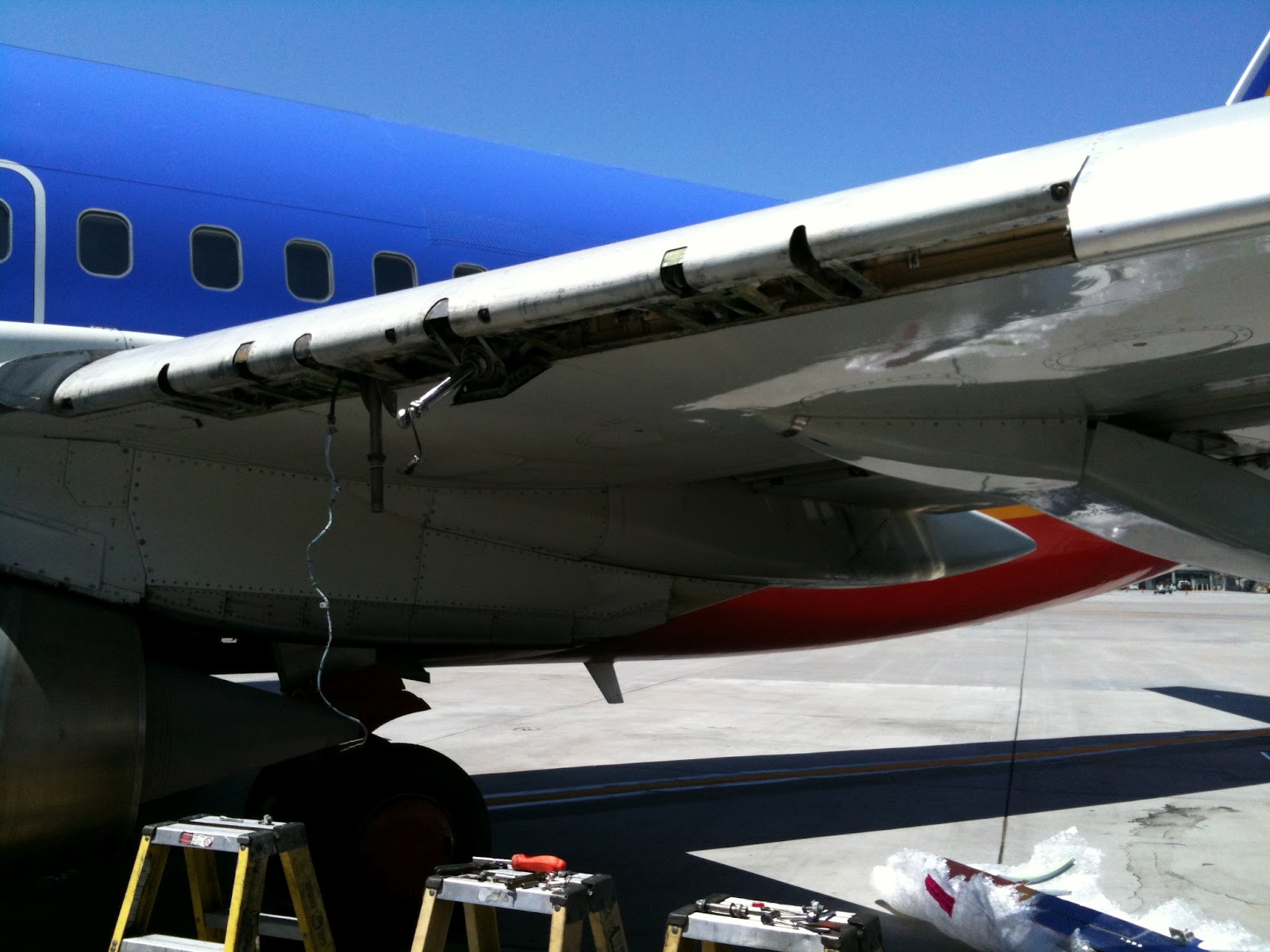
A plane was grounded when I got to work a couple of weeks ago. Not that unusual. What was unusual was the issue with the plane. this plane needed a stab trim cable replaced. We, in Oakland, have no experience with this type of job and in fact it is really considered a hangar job.


Another mechanic, Dr. was also starting his work week and we decided to work the plane since he, like me, enjoys doing jobs that we have never done before. There was a crew coming in from Phoenix to change out the cable but they were not going to arrive until around 11pm.

After checking the paperwork Dr. and I decided that there was plenty we could do while waiting for the Phoenix guys. Since I have a vast experience doing Cabin work (thanks Delta) I went inside and started to take apart the interior. What we had to do was to expose the Idler Pulleys in the system so that the new cable could be routed.

I took out the seats in the over wing area and pulled up the carpet and removed the floor panel and what do ya know...there were the pulleys.


Dr. in the mean time pulled the ceiling out of the bag bins to access more idler pulleys.

The Phoenix guys arrived and brought all those cool special tools that those hangar guys have. The best thing was that "the" cable guy came out with them. This guy, I'll call him The Cable Whisperer, pretty much only does cable and rigging jobs back in Phoenix.

Long story short we learned that changing those cables is not as scary as it first sounds. We learned a lot of tricks. We learned that a guy who has been working at this company for over 30 years can work circles around us!

One of the best parts of the job was when almost the entire roster of Day shift came out the next morning to help us out. Dr. and I had to leave but those guys closed up the plane and she is on her way making us money as we speak.

Wednesday, July 25, 2012

And In The End....

The very last day of my work week and I was looking forward to winding down the week on a nice easy note. When we came in on days they told us that a slat was damaged the night before and a new one was on the way. I have to admit I was not looking forward to working it and I decided not to volunteer my services when it came in. We did our normal thing that day and the new slat came in around 11am. The Lead Mechanic, I'll call him 20 Year Grudge, came in and asked who wanted to volunteer. No body moved or said a thing. He left and came back shortly and told one of the guys (lets call him F1) that he was going to help another guy, Banyan, on the slat.


I breathed a sigh of relief! I sat there for about 10 minutes then decided to go and help also. Crazy but true.

Banyan, F1 and 20 Year Grudge were just getting started and I jumped in where I could. Panels had to come off, the actuator had to be disconnected, the anti-ice duct also. Wires checked and moved and the puzzle of what the best way to remove the thing was slowly worked out. The Foreman (lets call him Surf) delivered our new slat and it was prepped.

As I was not assigned the job, when a gate call came over the radio I went to work it along with another guy so that these fellas could keep going. Around shift change 2:30pm the next player arrived-Tuna. Tuna was to be our inspector for the job. When we have large jobs or any time we mess with the flight controls we assign an inspector to look over the work and keep us all honest. Surf came over the radio "Banyan, you wanna stay for swing shift to finish the job?" Banyan was tired, he told me he could not wait to be done today so he could go home. I could tell he did not like the idea of staying but I knew that, like a lot of us, the idea of leaving a job half done was worse to him. He told the swing shift Lead (let's call him SkiBoat) that he would stay if they let Goat stay. he also said that if we stayed we could get the thing done in four hours. SkiBoat got on the radio and said "Hey Surf, Banyan will stay if we let Goat stay, he, Goat and F1 think they can finish in four hours." To my surprise Surf came back and said it was OK!

We got that old slat off and put the new one on. We actually put the new one on three times because we kept forgetting to hook up a wire or bracket or something. We finally got it up and Tuna inspected everything before we did our ops check. Tuna gave the OK to close the panels and we grabbed our screw guns and went to town.


We finished around 4:15 so all in all we spent about 5 hours on the thing. It felt good to work with guys that knew how to get a job done. No whining, no complaints just honest work. These guys don't stop for food or stupid things like that. They work hard and they work hard until the job is done. I am glad and proud to be in this group of workers and I hope that they feel they can rely on me the way I know I can rely on them.

One strange thing that happened: Once we were done and cleaned up F1 comes in and tells us that the plane we were working on is due to be retired in a month and a half! All that work and the plane is most likely going to the desert to be chopped up! We had shed sweat and even some blood to keep this thing flying and in the end...she was an old tired lady.

I have said it before and I will say it again, it's a strange feeling to know the plane you work so hard on is going to be leaving soon. All of us, for years worked hard to keep that plane going, "just get her over the fence" as we say. She no longer makes economical sense to keep around. Most likely she is timed out, too many cycles, not worth keeping with all the new more economical planes coming out. Like the 737-200s that this 737-300 replaced they will slowly fade away until they are stuff of legend, just a story to tell a probbie: "We used to change those heavy slats out here in the sun and rain and in the end...she was parked in the desert and dismantled."

Photo:Bobby Allison via airliners.net

Tuesday, July 3, 2012

Southwest 717 inspections

Most every one at SWA is happy to see the 717s go (Delta has decided to lease them). Here is an article about crack inspections that the FAA is requiring us to complete. Click the following link:

Southwest and Boeing seek delays in 717 inspections.

Monday, July 2, 2012

"What Else Can I Do?"

We work line maintenance. We do a great job of working line maintenance. Southwest Airlines is by far the best maintenance outfit I have worked for. Over the years I have learned a lot and had a lot of fun. One of the great things about this job is that I am constantly learning new things. One of the things that I have learned is that no matter how successful an organization is it can be eaten away from within by complacency.


There are a core group of guys at the job that work and work hard. The problem is that there is another group that does all they can do to actually do as little as they can. I know that I can't control the actions of others but it one of the things that really bugs me.

This post is not really about other mechanics doing the minimum to make their job easier. It is actually about me finding a way to behave at work that ensures I never fall into that trap. One of the good guys at work (lets call him The Dr.) came up to me a few weeks ago and said that on every gate call he does he tries to do something extra, something that the crew did not call for. This can be as easy as washing the windows when the crew calls for oils, checking the tires when you are called for hydro, etc. How easy is that?

Since beginning The Dr.'s method I have an increased sense of job satisfaction and it's really good to feel like you are going above and beyond in your job. Any of you who read this blog and are going to school for your A&P take my advise: When you are done with any task on an airplane (or anywhere for that matter) always ask yourself "What else can I do?" You will learn more, be more appreciated by co workers, become a better employee, and ultimately help your company's bottom line.


Let's not become a group of employees that always look for the easy way out, or always do the minimum amount of work. Let's keep our planes in top shape and the only way to do that is for all of us to take the extra step. When I got hired here at SWA we were able to say we had the best maintenance in the industry and I want to be able to say that when I retire as well. I will thank The Dr. for ya.